

I just spent a weekend with almost a thousand professional speakers, and I can’t stop thinking about something I didn’t see: earbuds.
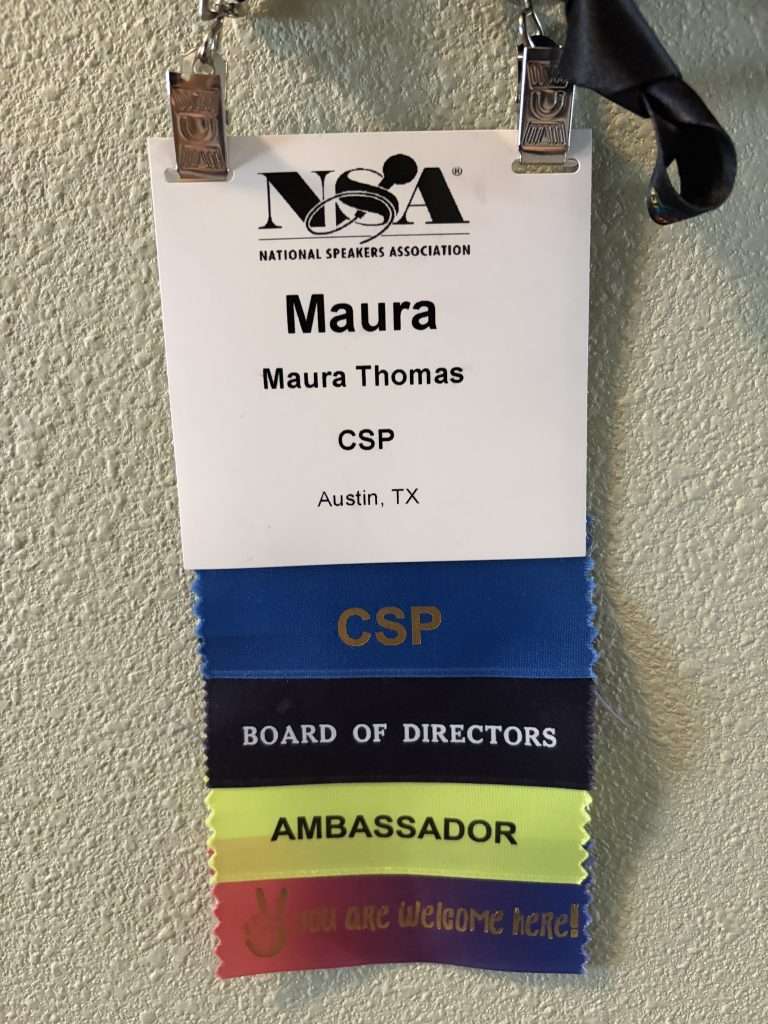
I was in a full day board meeting the day before the conference even started, then spent the weekend wearing several hats at once: board member, “Ambassador” to three first-timers, old friend, new connection, and eager student trying to absorb as much wisdom as I could from session after session. It was a lot.
It left me with three observations that have kept me turning things over in my head for a week now. All of them, perhaps not surprisingly, about attention: where it goes, what hijacks it, and what we lose when we let something else decide for us.
A weekend without earbuds, days of attention residue after one unprocessed meeting, and a phone that never left my hand all pointed to the same thing: attention is a resource we spend constantly, often without noticing the transaction. Some of it is default habit. Some of it is simply how a brain processes something left unfinished. Some of it is built by design. Recognizing the differences is what makes intentional choices possible.
No One Was Plugged In
All weekend at the annual gathering called Influence®, hosted by the National Speakers Association, I noticed the absence of earbuds where I usually see them all the time: on rideshare lines, in the gym, when people were sitting alone in the hotel lobby, or when they were taking a morning run.
It’s not like it was announced or anything. It seemed to be just a common understanding. Everyone in that hotel recognized that they were surrounded by people worth talking to. Old friends, potential new ones, a future mastermind member, referral partner, business partner, or just an interesting person with a great story.
So people stayed open. They looked up more. They sat in the hallway chairs between sessions, smiling at people as they went by. Their behavior signaled availability, and that signal is what made the whole weekend feel different.
Normally, the default posture in public spaces is earbuds in, heads-down. And we’ve normalized it so completely that we’ve forgotten it’s a choice, not a law of nature. I have story after story, and I’d bet you do too, about relationships (a best friend, a spouse, a mentor, a client) that started in one of those solitary moments that led to an unexpected connection, like the seat next to a stranger on a plane, the line at a coffee shop, the ride in an elevator.
Those moments haven’t disappeared. We’ve just made ourselves unavailable for them, because our phone is our constant companion.
I’m not saying that you should never listen to a book or a podcast when you’re on-the-go. That’s not realistic or useful. But I do think it’s worth considering that every time we default to the phone in a quiet moment out in the world, we’re not making a neutral choice. We’re opting out of a category of experience we’d probably say we value if you asked us directly.
Attention management isn’t just about focus, and it’s also not about willpower or abstinence. It’s about noticing that “the choice of how to show up” is happening at all, so you can occasionally choose differently.
What ‘Attention Residue’ Actually Feels Like
The second thing I noticed was less appealing, because it was about how I was showing up.
That board meeting the day before the conference left my brain full, spinning with ideas, half-formed decisions, things I wanted to follow up on. Normally I create some buffer to focus my thoughts and process my experience before moving on to the next thing.
In this case, I didn’t get one. The meeting ended, and I walked straight into a wave of arriving attendees, dinner plans, and evening events that swallowed every thought I hadn’t finished having. And my brain didn’t let it go. It kept processing in the background for days, showing up as disrupted sleep and a nagging difficulty to fully focus on other things that weekend, even when I wanted to.
In my work, I’ve recently started focusing on the concept of “attention residue,” and this is a great example. Attention residue is emerging as a core piece of attention management that a lot of advice about focus and discipline completely ignores. Your brain doesn’t stop working on something just because you’ve moved on to something else. Unprocessed thoughts don’t evaporate. They hang around, popping up at inopportune moments until you give them the closure they need. I know this. I teach this. And yet I found myself, days after the conference ended, still feeling something like a hangover from it — foggy, slow to reconnect, second-guessing how I’d shown up for people. I reflected on the fact that I missed a special event being held that weekend, that was important to me, because I was trying to juggle too many things. So then I started to wonder about other things: if I greeted everyone I should have, if I seemed distracted when someone was telling me something that mattered to them, and if my first-timers got the attention they deserved from their Ambassador.
I can’t answer those questions without perfect recall, which I certainly don’t have (memory is another casualty of fractured attention). What I realized is that the amount of unprocessed input I was carrying wasn’t unique to a conference weekend. It’s the ambient condition of modern life, just usually spread out enough that we don’t notice the toll. But compress a normal month of stimulation into four days, and the attention residue becomes impossible to ignore.
That’s useful information, even when it’s uncomfortable. I bet you’ve experienced this, but couldn’t recognize it, because maybe you didn’t have a name for it.
The Choice of Constant Connectivity
The third thing I noted about the weekend was that everything ran on text. Who was doing what, where to meet, which sponsor to thank, which first-timer to check on — all of it arrived as a notification on my screen. My phone was always in my hand in a way it normally isn’t, because the coordination of an entire weekend depended on it.
And this made me feel constantly fractured: being physically in one space while coordinating several other things in a digital space.
I realize there might seem to be a contradiction here. The same weekend I noticed no one withdrawing into earbuds, my own phone barely left my hand. But in thinking about this, it occurs to me that these aren’t the same issue, they are actually two different types of digital distraction.
The earbuds problem is about using a phone in a way that isolates. The texting problem is about using a phone to bring people together. One withdraws presence; the other orchestrates it. Though, as I found, orchestration has its own attentional price.
The same device that fragmented my attention also created the spontaneous dinner, the last-minute meetup, the connection that wouldn’t have happened without a quick text across a sprawling hotel with events on three different floors.
Without phones, there would have been fewer of those engineered, intentional moments, but more of the serendipitous ones. The kind that happen when you’re forced to just show up somewhere and see what happens. Is one better than the other? No. The context matters.
I think the choice is worth noticing, but I’m not interested in the “technology is good” or “technology is bad” argument. That framing is a dead end, and it’s also not really the point. A phone is no longer optional in a room full of people who need to be reachable.
What’s optional, and what’s actually within my control, is how much authority over my attention I relinquish while it’s in my hand. A phone that helps me find the group meeting for dinner is a tool used by me. A phone that fractures my focus in every conversation because I’m braced for the next notification is a tool used on me.
And that is by design.
Our devices, and the apps running on them, are built by organizations whose business model depends on capturing exactly the kind of reflexive, constant checking I was doing all weekend. Recognizing that design is the first step in not being ruled by it.
Where This Leaves Me
I’ve been teaching attention management for years, mostly through the lens of individual and team productivity: how to manage your attention, how to take control over your work, how leaders can manage the culture so deep work is possible.
This weekend was a reminder that there’s so much more to explore. The harder problem isn’t just personal discipline anymore. It requires the recognition that we’re all moving through an environment engineered, quite deliberately, to fragment our attention and keep us reactive.
One marketing angle of a smartphone is that it offers the ability to be constantly connected. The profitable benefit to smartphone manufacturers is that constant connectivity makes us reliant on our phones.
Understanding that tradeoff—not just the benefit we get but the cost we pay in return— is critical and has been ignored for a long time. The mechanics of how these systems pull at us, is where I think the real work on attention management is now. What it actually takes to stay the one steering, instead of the one being steered. Not “breaking up with our smartphone,” and pretending we can opt out of a connected world.
But something more like cognitive self-defense: knowing the tricks well enough that they stop working on us by default.
That’s the lens I keep coming back to as I replay my conference weekend. The no-earbuds phenomenon, the attention residue, the double-edged phone — they’re really the same story told three ways. Attention is the resource being spent, whether or not we notice the transaction.