Updated March 28, 2026
If it feels harder than ever to pay attention, it’s not a personal failure—and it’s not your imagination.
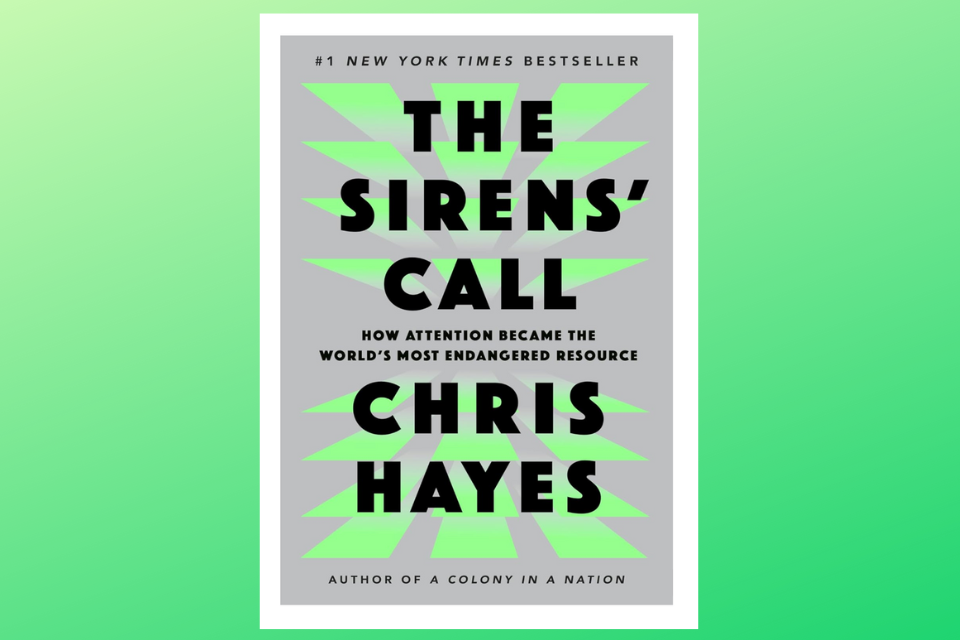
I was excited to read Sirens’ Call, and it did not disappoint. In it, Chris Hayes makes a clear and unsettling case: attention management has quietly become one of the most valuable skills in modern society. And like any valuable resource, it is actively extracted, traded, and exploited.
The result is a world where people feel constantly busy, endlessly interrupted, and increasingly dissatisfied with how they spend their time—even when they’re working hard.
What Sirens’ Call Argues
At its core, Sirens’ Call advances a simple but powerful idea:
Attention is no longer just personal—it is economic.
Hayes argues that many of the systems shaping modern life are designed not to support our ability to focus, but to capture and hold attention because attention drives profit, influence, and power.
In practical terms, this means:
- Distraction is not a bug—it’s a feature
- Attention is treated as an asset to be harvested by algorithms
- Individuals are left to manage the consequences
This framing helps explain why conversations about attention management have become so urgent—and why individual strategies alone often feel insufficient.
How the Attention Economy Works
The attention economy rewards whatever keeps people engaged, reactive, and emotionally activated. Over time, this has reshaped how information is delivered, how work is structured, and how people relate to one another.
Key characteristics of the attention economy include:
- Speed over depth
Fast responses are rewarded more than thoughtful ones. - Urgency over importance
What demands attention now crowds out what matters most. - Volume over meaning
More content, more messages, more signals—regardless of value. - Emotion over reflection
Outrage, novelty, and fear keep attention locked in. - Visibility over impact
Being seen as responsive often matters more than producing meaningful results.
Algorithms amplify whatever keeps people clicking, scrolling, and reacting. Notifications are calibrated to interrupt, and workplace norms increasingly equate availability with commitment.
Hayes’s point is not that technology itself is harmful, but that incentives shape behavior. When attention is the currency, fragmentation becomes profitable and our ability to proactively pursue our most significant results becomes infinitely more challenging.
Why Attention Management Feels So Hard Now
From this perspective, the modern struggle to manage attention is not mysterious. It is structural.
People are trying to do deep, meaningful work in environments that:
- Normalize constant interruption
- Reward immediate responses
- Blur boundaries between work and rest
Even highly motivated people find themselves pulled off course—not because they lack discipline, but because the environment is working against them.
Why Traditional Productivity Advice Falls Short
Much productivity guidance assumes distraction is an individual problem.
If you’re struggling, the implied solution is often:
- Better habits
- Better tools
- Better self-control
Sirens’ Call challenges this assumption.
Hayes suggests that without addressing the systems shaping attention, personal strategies will always be fragile. You might manage to focus temporarily, but the pull of the environment eventually reasserts itself.
Sustainable focus requires structural support—clear boundaries, shared norms, and intentional design—not heroic effort.
Why This Matters
When attention is continuously divided, the cost isn’t just lost productivity.
Over time:
- Deep thinking becomes difficult and rare
- Complex problems are harder to solve
- Work feels busy but unsatisfying
People end the day exhausted, yet unsure what they actually accomplished.
Understanding how attention is shaped—and why it feels under constant threat—is a necessary step toward reclaiming it.
Key Takeaways from Sirens’ Call
- Attention is now an economic resource.
Focus is shaped by systems designed to capture and monetize it. - Distraction is intentionally engineered.
Many digital platforms profit by keeping people reactive and fragmented. - Productivity struggles aren’t personal failures.
Willpower alone can’t overcome environments built for interruption. - Sustained focus requires structure.
Clear boundaries and shared norms—not hacks—make meaningful work possible.
Resources for Protecting Attention
For readers who want to explore ideas aligned with the themes in Sirens’ Call, these organizations focus on reclaiming attention outside algorithm-driven environments:
- Friends of Attention
A community exploring intentional, human-centered approaches to attention. - Strother School of Radical Attention
A learning space dedicated to cultivating focus, reflection, and depth in a distracted world. - Visit the Learning Center at MauraThomas.com
Find my books, articles, and other resources about how to build your attention management muscle and improve your work and life.