

You probably don’t need anyone to convince you that task management matters. Keeping track of your commitments, planning ahead, and knowing what to work on next all make work easier.
Sticking with a task list is another matter. I’m sure you’ve made more than one valiant effort to use a task list to organize your work in the past.
Maybe you downloaded a promising app, set it up with color-coded labels, and used it faithfully… for a few days, or a couple of weeks. Maybe you tried a technique a colleague swears by and watched the benefits fade along with the novelty. Maybe you’ve even tried suggestions from someone like me, and walked away convinced my system just won’t work for you.
None of that means you lack discipline, that you picked the wrong tools, or that you’re “just not an organized person.” And it doesn’t mean systems and tools can’t work for you.
The problem is that when there’s work to be done, doing it feels more productive than thinking about it. The result is a list, and mind, full of things you haven’t actually decided anything about. The list keeps getting longer, it doesn’t tell you what to work on next, and looking at it starts to feel like more work. Meanwhile, more and more details begin to weigh heavily on your mind, demanding attention and pulling you further away from opportunities to plan and organize.
The secret to successful task management is changing how you think about your work. That means deliberately setting aside time for that thinking, turning the thinking into decisions, and recording those decisions where they’ll be easy to find later, when it’s time to act.
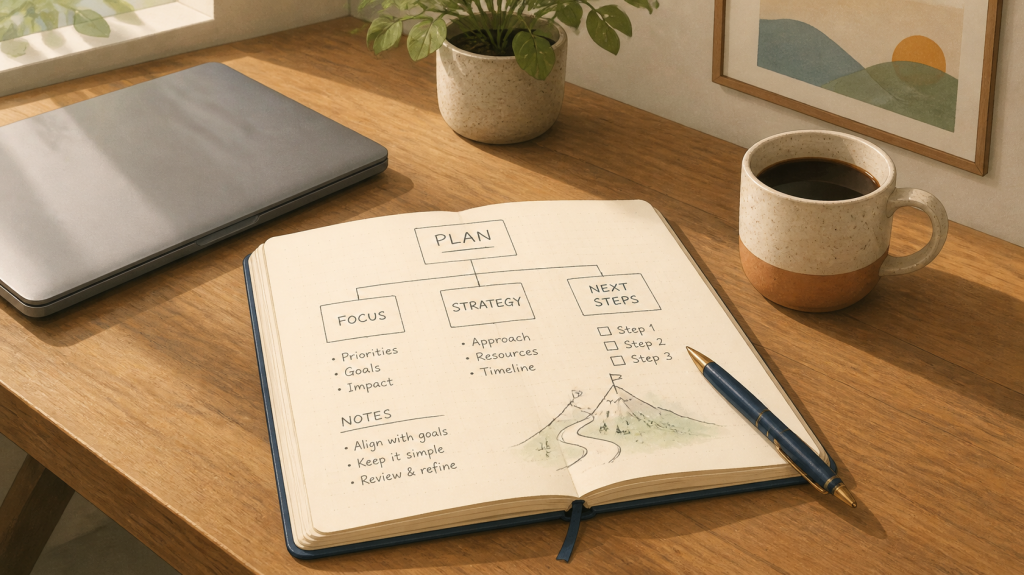
Task management begins before you create a task
If you’re a knowledge worker (working primarily on a computer for much of your day), your job is basically doing a lot of thinking. You solve problems, make decisions, write, analyze, and respond to whatever comes up. That’s thinking about what you’re doing in that moment.
Thinking about your work is different. It means stepping outside of execution mode to consider what you’re supposed to accomplish, how you’ll approach it, and whether that approach makes sense.
Imagine someone dedicating several hours to a presentation, meticulously selecting content, polishing the language, and designing sleek slides. However, they failed to clarify the meeting’s purpose with the requester, resulting in a comprehensive overview for an audience expecting a quick recommendation. Their extensive thinking was ultimately unproductive due to a lack of planning for the task itself.
That’s why I define task management this way:
Task management is the practice of making and preserving good decisions about work, so you can execute effectively and efficiently.
Keep planning separate from doing
When you set aside time to think about your work, you’ll notice an email you could answer in a minute, a problem you could solve right now, or a small task you could knock out.
Those actions are tempting because they offer instant evidence of progress. But follow them, and ten minutes later you’re deep in your inbox while the thinking you sat down to do hasn’t happened.
The purpose of planning time is to make and preserve decisions, not to carry them out. So when an action occurs to you, capture it for later. Make that your default. There will be occasional exceptions, like a time-sensitive request from a colleague. Just don’t let immediate action take over the time you set aside for thinking.
You may also find that the hardest part is finding the time at all. If your days are a steady stream of meetings, messages, and quick questions, even a few uninterrupted minutes can feel like a luxury. That isn’t a personal failing, and it isn’t entirely yours to fix. How a team handles messages and meetings shapes how much thinking time anyone gets, and leaders have more influence over that than any individual does. In the meantime, start small. A few minutes before your first meeting or after your last one, with notifications off, is enough to begin.
Thinking about your work is part of doing your work well.
What to think about when you plan your work
Imagine sitting down for 15 minutes specifically to think about your work. What would you actually think about?
If you’re not sure, that alone can make planning time easy to skip. The good news is that it doesn’t have to be complicated. Most of what matters fits into five subjects.
| Think about… | Ask yourself… |
|---|---|
| 1. What I’m expected to accomplish | What needs to happen, and what will success look like? |
| 2. How I’ll accomplish it | What’s my approach, and what should I do next? |
| 3. What I’ll need | What information, tools, resources, or other support will I need to succeed? |
| 4. Who else is involved | Who needs to contribute, make decisions, provide information, or know what’s happening? |
| 5. Whether I’m on track | Is my plan working, and do I need to change anything? |
Between them, these cover understanding expectations, judging feasibility, preparing to act, coordinating with others, solving problems, and adjusting as things change.
They aren’t steps to complete in order, and you don’t need all five every time you stop to think. Start with whichever subject needs your attention most. Often, considering one reveals something about another. Thinking through who else is involved, for example, might show you that you don’t fully understand what you’re expected to accomplish. When that happens, don’t try to work it out on your own. Write down the question and who can answer it, because that’s a useful result of your thinking too.
Once you know what deserves your thinking, the next challenge is turning that thinking into decisions.
Turn your thinking into decisions
Understanding a situation better doesn’t tell you what to do about it. The value comes from deciding what you’ll do, how you’ll do it, and when.
Imagine you’ve been asked to improve your organization’s client onboarding process. Rather than immediately revising the welcome materials or scheduling meetings, you take some time to think it through.
Starting with what you’re expected to accomplish, you realize the request was vague, so you decide to confirm with the person who asked for it what a “better process” would look like, or where the failings are in the current process. You make a note to request a kickoff meeting. That makes you realize that reviewing recent client feedback would be helpful to prepare for the kickoff meeting, so you reserve an hour on Tuesday to do it. Thinking about who else is involved, you decide to talk with two colleagues who work directly with new clients, so you make a note to invite them to the meeting. And to give yourself a checkpoint, you decide to bring them your recommendations by next Friday.
You haven’t revised a single document yet. But you now have a direction, a sequence, a timeline, and the people you need. Those are decisions you can record now and act on when it’s time.
Make your decisions specific enough to act on
Some decisions set the direction: what you’ll accomplish and why a particular approach makes sense. Others cover execution: how and when you’ll do the work, who will contribute, and what you’ll need.
The most useful distinction is between deciding on an approach and deciding on an executable action. “Review client feedback” identifies an activity. “Review the last ten onboarding feedback responses and list recurring complaints” tells your future self exactly where to start and how to know when you’re finished. (It’s the same principle behind making your to-do list actionable.)
Research supports the value of this kind of specificity. Psychologist Peter Gollwitzer studies what he calls “implementation intentions:” plans that link a specific situation to a specific response, such as “When I sit down at my desk Tuesday morning, I’ll open the feedback file.” A 2006 meta-analysis by Gollwitzer and Paschal Sheeran, covering 94 independent tests, found that forming these plans had a medium-to-large effect on reaching goals.
How specific each decision needs to be depends on the work and its circumstances. And as you make decisions, capture them, along with the timing and context, in a reliable system so you won’t have to reconstruct your thinking later. (More on that below.)
Some decisions can’t be made yet
Sometimes important information is missing. You may not know how long something will take or what you’ll discover once you begin.
That doesn’t mean your planning has failed. You can make a provisional decision and plan to revisit it, or deliberately postpone the decision until the information appears. The goal is to make and preserve the decisions that will help you act effectively, rather than to make every possible decision in advance.
So how do you know which decisions to make now, and how specific they need to be?

Decide what decisions can be made now, and what can wait
You won’t always have enough information to decide everything about your work, and deciding everything up front isn’t always useful anyway. Here’s the principle I recommend:
Get clear on what you’re trying to accomplish, and at least one specific next step (or more, if those are obvious). Make some notes about the rest and know that you’ll gain clarity as you progress through the steps, and you’ll proceed through roughly three stages:
Short-term clarity (what you can know now): Your expectations, desired outcome, important commitments, whether the work is feasible, and your next one or two actions. If the outcome itself is uncertain, deciding how you’ll clarify it can be your next action. Make the decisions the available information supports, and record the relevant details so you won’t have to rebuild them later.
Provisional clarity (what you can reasonably plan with the limited information available): your best-guess about Intermediate steps, dependencies, resources, responsibilities, and timing—really any other ideas you have about the project that you can note now, with the understanding that they may change as new information becomes available.
Abstract for now: Distant or uncertain work whose details depend on information you don’t have yet. You’ll return to those decisions as the work moves forward. Some requirements, obstacles, and opportunities only show up once you start. You can’t plan for them directly, but you can revisit your plans regularly and adjust when they appear.
This isn’t simply near-term versus distant work. Some decisions about work that’s months away could be made today, like getting time on a busy colleague’s calendar before it fills up. Others would be premature even if the work starts next week. The real question is whether you have enough information to make a useful decision right now.
Back to the onboarding project. You know client communications need improvement, but you don’t yet know which messages are causing confusion. So you decide now to review the feedback and interview your colleagues, and you leave the specific revisions undecided until you have their input. Your plan is incomplete, and it’s exactly as complete as it should be at this stage.
Planning continues while you work. As you learn more, decisions that were premature become possible, and some earlier ones will need revising. You don’t need to know everything in advance. You need to make the best useful decisions you can now and refine them as you go.
Even when you have enough information to decide, there’s one more judgment to make. At what point do you stop planning and start taking action?

When should you stop planning and start doing?
Too little thinking leads to confusion, wasted effort, missed expectations, and avoidable mistakes. Too much thinking delays progress, can become a comfortable form of procrastination, and tends to produce elaborate plans that are out of date soon after you finish them.
There’s no universal rule for how much thinking a piece of work deserves. It’s a bit like an artist deciding when a painting is finished. No measurement tells them, but experience and judgment do.
When you’re unsure, ask yourself: “Would more thinking help me make a better decision, or would I learn more by taking action?”
Your judgment improves with practice, especially if you pay attention to how your decisions turn out. Sometimes you’ll act too soon and discover you overlooked something important. Other times you’ll realize you spent an hour planning something that needed ten minutes. Both teach you something for next time.
The goal is to think enough to support effective action. And once you’ve made enough decisions to move forward, you need them available when it’s time to act. That’s the job of your task management system.
Your task manager preserves the results of your thinking
The decisions you make today might not be needed until next week or several months from now. If they exist only in your memory, you’ll either forget them or spend time reconstructing your thinking. Your brain is a lousy file cabinet, and it’s an even worse place to store decisions.
Planning may also take some weight off your mind. In a series of studies published in 2011, psychologists E. J. Masicampo and Roy Baumeister found that unfinished goals tended to intrude on people’s thoughts and interfere with unrelated tasks, and that making a specific plan for those goals eliminated those effects. My practical takeaway: once you’ve made a plan, record it somewhere you trust so your mind doesn’t have to keep holding it.
A reliable task manager holds more than task names. Depending on the work, it preserves:
- Commitments and expectations
- Desired outcomes, and why they matter
- Specific next actions
- Deadlines and other meaningful timing information
- Information you’ll need to begin or resume the work
- Decisions waiting on information or follow-up
- Work you’ll need to reconsider as circumstances change

Why task lists get abandoned
A list full of items like “Client onboarding” holds reminders of work you still have to figure out, and every time you look at it, you have to do that thinking on the spot, usually when you have the least time for it. And when nothing on the list has been decided, there’s no way to compare one item with another, so choosing what to work on becomes guesswork. That friction turns the list into one more source of stress, and after a couple of weeks it’s easier to stop opening it. A good task description makes sense to the person who reads it later, and that person is you, on a busy day, with your attention somewhere else. In the example above, the “review feedback” task from earlier gives you a clear place to start and a clear finish line.
What makes a good task manager? It goes everywhere you do, and it holds both your work and personal tasks, because they’re all part of one life. It lets you set due, or ‘do on’ dates, add notes and context to a task, and view your list by project, category, or due date. Beyond that, choose the simplest tool that does those things, because a task manager that feels like one more thing to manage won’t get used.
Keep your task manager aligned with reality
Work changes as you learn, circumstances evolve, and commitments are completed or renegotiated, so your task list needs regular attention. Reviewing it is more than administrative housekeeping. It’s a chance to reconsider earlier decisions, notice missing work, and keep your commitments realistic. It’s also where you remove items you’ve decided not to do, renegotiate the ones you can’t do, and move others to a later list, so the list reflects what you’ll actually do rather than everything you’ve ever thought of.

Start with one five-minute exercise
Choose one responsibility, unresolved issue, or project that’s been occupying your attention or sitting on your list for a while. Set aside five minutes to think about it, using the five subjects:
- What am I expected to accomplish?
- How will I accomplish it?
- What will I need?
- Who else is involved?
- Am I on track?
You don’t need to answer every question. Focus on the ones that will help you make useful decisions. Be as specific as you reasonably can about the outcome you want and what you’ll do next. If you’re missing information, decide how or when you’ll get it, or leave that decision for later.
Then record what you decided, including any actions, timing, and context you’ll want when you return to the work. Resist the urge to start on those actions now. For these five minutes, your job is to think about the work, not perform it.
Five minutes won’t be enough to plan most projects, and it doesn’t need to be. The point is to make one or two valuable decisions and notice what that feels like. When you finish, ask yourself: “Do I feel clearer about this work, better prepared to act, or more confident about what needs to happen?”
If the answer is yes, try it with something else. Over time, thinking deliberately about your work becomes a natural part of how you manage it.
Successful task management starts with better thinking about your work and a reliable place to keep the decisions that thinking produces. A better list follows from there.
The five-minute exercise shows you how you’re thinking about one piece of work. If you’d like to see how the rest of your work habits are serving you, take the free Empowered Productivity Assessment. It takes about 15 minutes, and you’ll receive a personalized report with specific suggestions for what to work on next.