
Part 4 in a series on the 2025 Microsoft Work Trend Index Report
Businesses are navigating a profound shift, one that parallels the Industrial Revolution and the rise of the internet. This decades-long transition to the AI work world is characterized by intelligence being “on tap.” In other words, artificial intelligence can be turned on and off like a faucet by humans skilled in using this widely available resource.

The Series
This article is the fourth in a series of articles inspired by the 2025 Microsoft Work Trend Index Annual Report. Other articles in this series include:
Article 1: Frontier Firms: Microsoft’s Jaw-Dropping Report
Article 2: How to Improve Work Culture by Fixing the Infinite Workday
Article 3: Too Much Work? When Hustle Hurts Results
Article 5: Revolutionize Internal Communications with Microsoft Copilot Notebooks
In the near future, success will require every professional to behave like the CEO of an agent-powered startup, directing specialized digital labor. Right now, data indicates that leaders are ahead of employees in preparing for this future. As a result, leaders are demanding new training and operational models to help employees catch up.
This article provides guidance for all knowledge workers on how to manage this complex transition.
The Leadership Imperative: Cultivating Capacity

How will AI affect the workplace of the future? In a Frontier Firm, every employee will act as an agent boss. The transition to this reality, however, depends on leaders who can intentionally design a culture that supports high-value human work and a continuous learning environment.
The professionals taking a proactive approach to up-leveling their skills—not just technical skills but also workflow management skills—will have an edge in the labor market of the future.
Leaders will need to redefine organizational structures and invest in the capabilities of their employees. The Microsoft report shows that 32% of managers plan to hire dedicated AI agent specialists to develop and optimize agents within the next 12–18 months. Also, 28% of managers are considering hiring AI workforce managers to lead hybrid human-agent teams.
Within the next five years, leaders anticipate a radical restructuring of team responsibilities, including automating complex tasks with multi-agent systems and using AI to redesign business processes.
The Disparity: Leaders vs. Employees
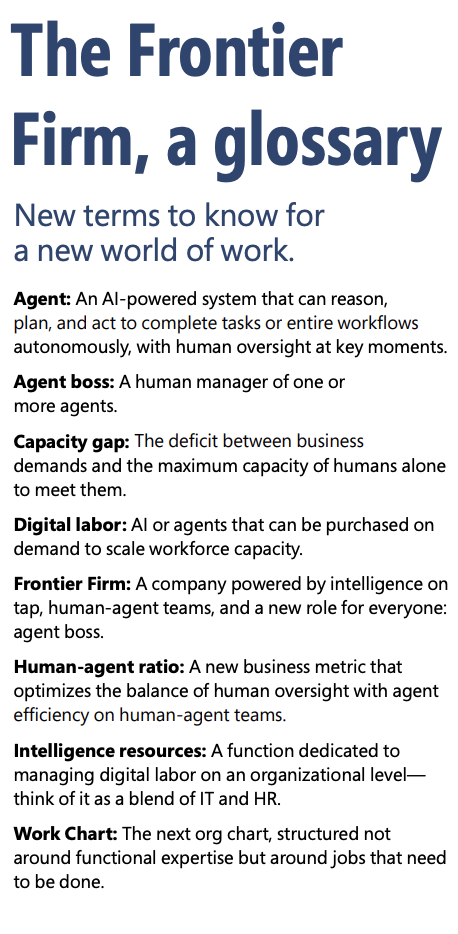
The destination of this profound shift in work is the Frontier Firm, which the Microsoft study defines as organizations that will be powered by “intelligence on tap” in the form of AI, as well as by dynamic human-agent teams.
Achieving this future will require every worker, whether they are currently a leader or an employee, to evolve into an agent boss. The agent boss will be responsible for building, delegating to, and managing AI agents that can reason, plan, and act autonomously.
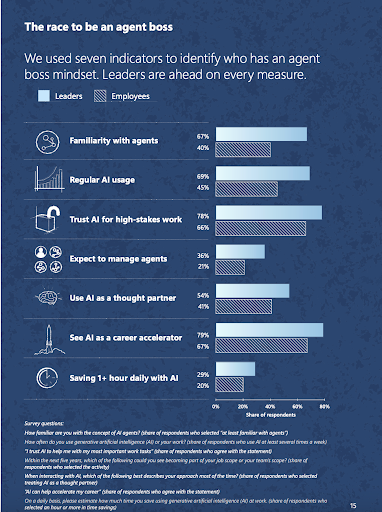
However, right now, preparation for this shift is uneven. There is a significant disparity in how ready team members are to embrace our new AI reality. Data from the Microsoft report shows that leaders are ahead of employees on all seven indicators used to determine an “agent boss mindset.”
To close this gap, employees need more than access to tools; they require specific training and a new operational framework.
Workflow Skills Grounded in Attention Management

The transition to the Frontier Firm requires human professionals to operate as agent bosses, guiding intelligent digital labor that handles complex automation.
This role demands high-value human capabilities—judgment, creativity, and full brainpower—which cannot be mustered in the current state of constantly fragmented attention that exists in modern offices today.
Workers now face relentless distractions (up to 275 interruptions a day), and demand for productivity exceeds what humans alone can deliver, creating a capacity gap in the workforce. Attention management is the essential antidote, replacing time management. After all, a distraction problem can’t be solved with a “time” solution.
Mastery of attention management skills and other critical workflow skills enables professionals to achieve significant results and unleash their genius. Key components include empowering employees to set clear boundaries, teaching behaviors that allow them to work proactively rather than reactively, and resetting a culture of urgency.
By addressing these challenges, employees can regain the sustained focus required to apply the wisdom and experience they were hired for.
AI and the Future of Work: The Path Forward

The multi-decade journey to the Frontier Firm will be won by organizations that treat human attention as a strategic asset. The shift from a culture of constant distraction to one grounded in attention management starts with comprehensive workflow management training.
My flagship program, which will soon include a practical AI module, helps your team accomplish more of the right work with less stress and fewer distractions.
Click the button above to learn more about the Empowered Productivity workflow management training for your team. By creating an organizational culture where people actually want to work, you protect your most critical resources—the time, energy, and judgment of knowledge workers—and you position them to maximize their unique talents throughout the AI transition.